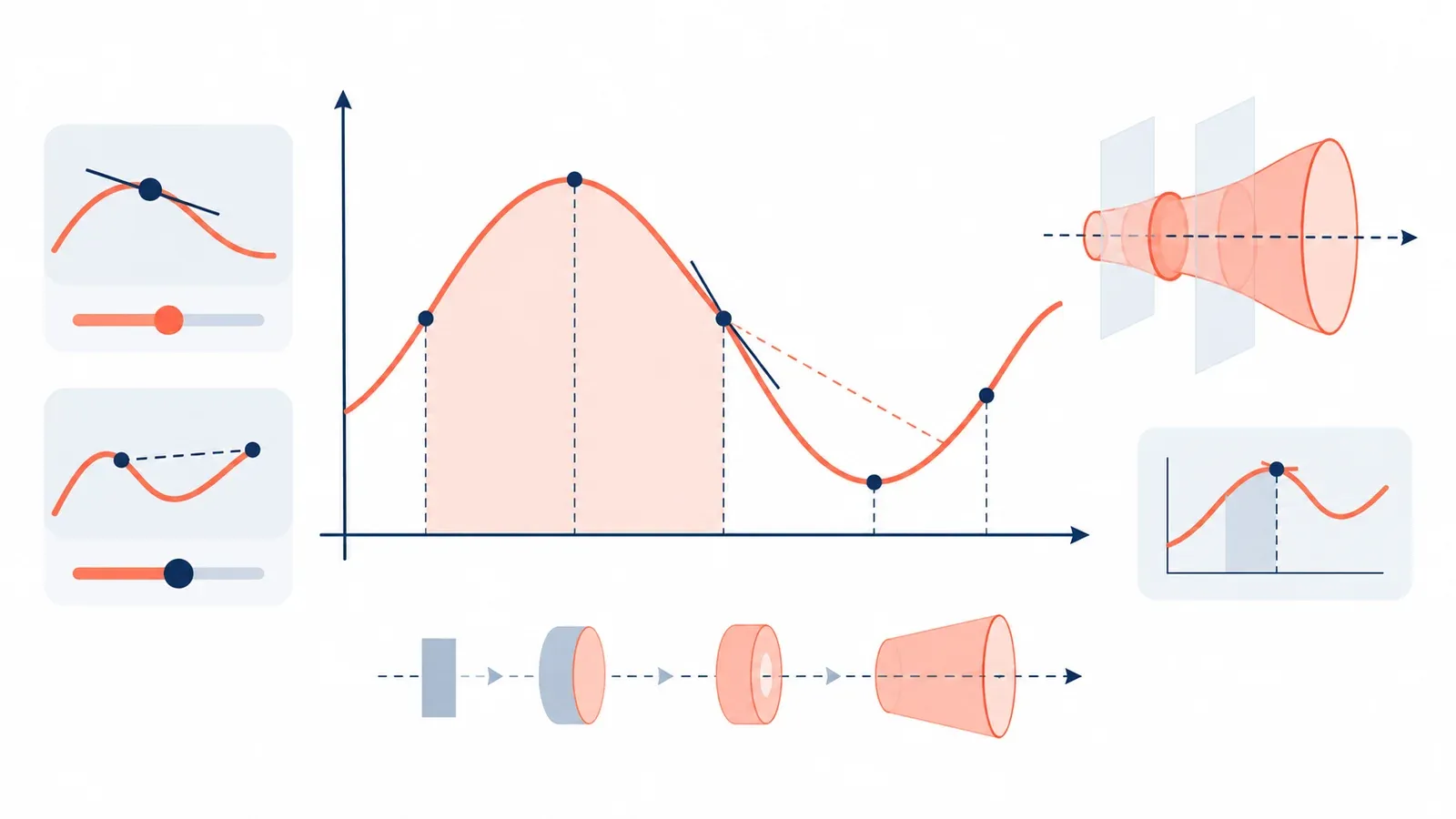
The calculus shape and rate explorer takes a polynomial. It shows its gradient function, an antiderivative, a tangent line at a point you choose and any stationary points. It also shows the signed area and the geometric area over an interval.
The working is exact, and an independent numerical check confirms it.
How do you use it?
- Type a polynomial in f(x), for example x^3 - 2x + 1. Use whole-number powers from 0 to 6.
- Enter Tangent at x = for the point where you want the tangent line.
- Enter the interval from a and to b. The value a must be smaller than b.
- Press Work it out. Press Reset to return to the sample.
How do you read the result?
The result starts with f(x), its derivative f′(x) and an antiderivative F(x) written without + c.
The tangent section gives f(x) and the gradient at your point, then the line as y = mx + c. The stationary points section lists where f′(x) = 0 inside your interval.
The area section gives two numbers.
The signed area is F(b) − F(a). The geometric area splits the interval where f changes sign and adds the absolute values of the pieces. The tool notes where the sign changes.
The independent check uses Simpson’s rule, a numerical method, and shows how close it is to the exact values. The graph shows the curve and the tangent.
Example walk-through
The sample is f(x) = x, tangent at x = 0.5, interval −1 to 1.
- f′(x) = 1, so the tangent at 0.5 has gradient 1 and passes through (0.5, 0.5). Its line is y = x.
- F(x) = 0.5x². Signed area = F(1) − F(−1) = 0.5 − 0.5 = 0.
- The line crosses the axis at x = 0, so split there. The pieces are 0.5 and 0.5, giving geometric area 1.
Both areas come from the same curve but answer different questions. Signed area lets regions cancel. Geometric area does not.
Now try f(x) = x^2 - 1 on the same interval with the tangent at 0.5.
The derivative is 2x, so the gradient at 0.5 is 1. Since f(0.5) = −0.75, the tangent is y = x − 1.25. The stationary point is at x = 0, y = −1.
The curve stays below the axis, so signed area is about −1.3333 and geometric area is 4/3: same size, different sign.
What are the assumptions and limits?
- Only polynomials with whole-number powers from 0 to 6 are supported.
- The numerical check is an approximation, and its difference from the exact value is displayed.
- The antiderivative leaves out + c.
- The interval must have a smaller than b.
- The tool works with the graph you enter. It does not choose an interval or a method for a word problem.
Which lessons explain the ideas behind it?
- Differentiate a polynomial with fractional powers builds the differentiation rule.
- Differentiate a product where applicable and apply a chain rule to a composite expression extend it.
- Recover a function from its derivative and a point explains the constant of integration.
- Integrate a power with the correct constant covers the power rule for integration.
- Evaluate a definite integral with correct limits explains F(b) − F(a).
- Check an antiderivative by differentiation uses the two operations against each other.
- I can differentiate but cannot form an optimisation model helps when the rules work but the setup does not.
The wider topics are differentiation techniques and integration methods, with mixed sets in differentiation practice and integration practice.
If the rules work but the setup does not, a teacher in online one-to-one Additional Mathematics tuition can help you build the model from the question. Other tools are in the learning tools directory.